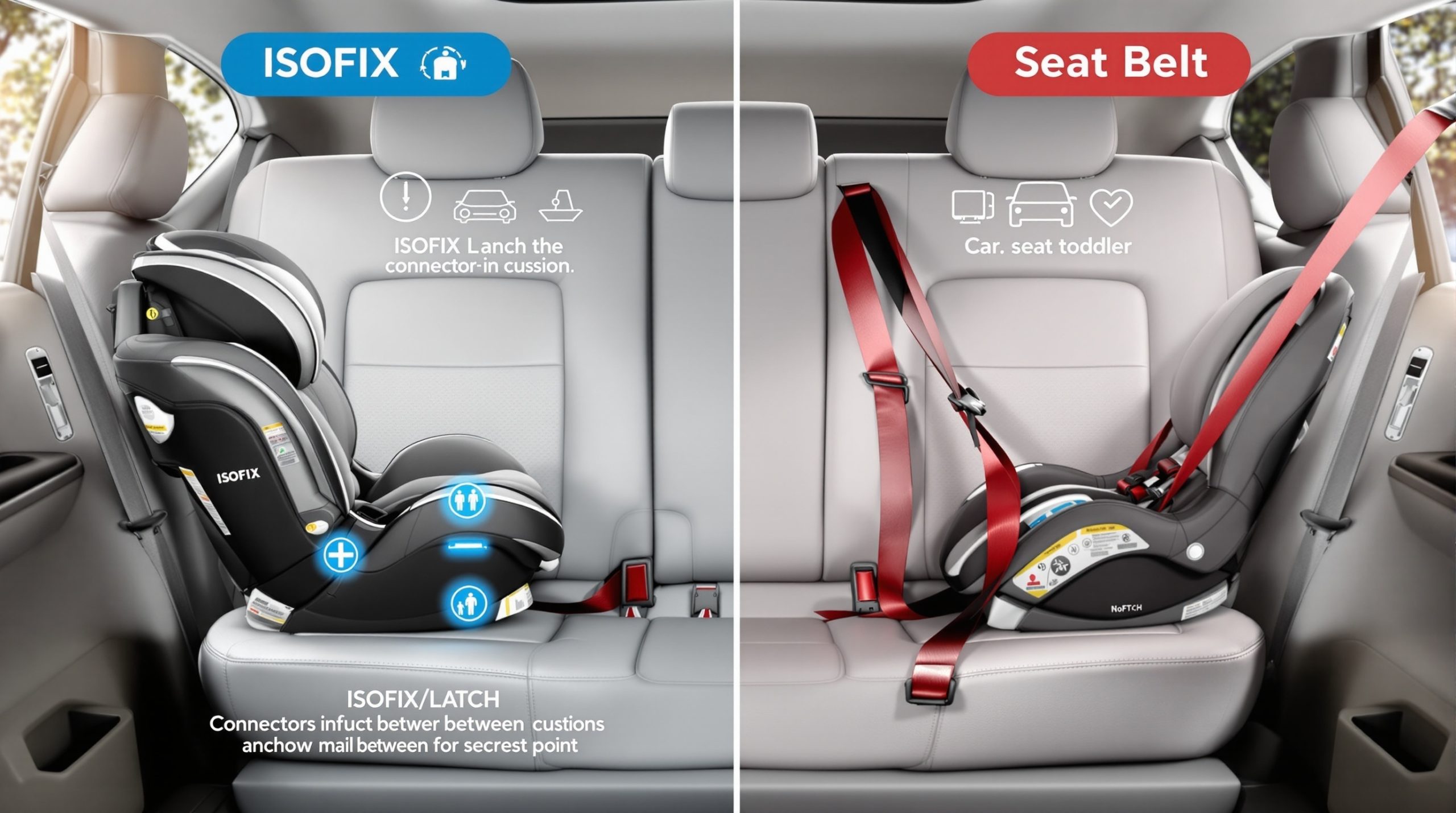
When installing your child’s car seat, you have two main options: ISOFIX (also called LATCH in North America) or a traditional seat belt. But which method is actually safer? This comprehensive guide breaks down the differences, pros, cons, and helps you choose the best installation method for your vehicle and child.
Understanding Car Seat Anchor Systems: ISOFIX vs Seat Belt
Before we compare safety, it’s important to understand what each system is and how they work:
What is ISOFIX (LATCH)?
ISOFIX stands for International Standardization Organization FIX, while LATCH is the North American acronym for Lower Anchors and Tethers for CHildren. These are metal connectors built into your vehicle’s rear seat that attach directly to your car seat—no seat belt required.
Key Features:
- Two lower anchor points located between the vehicle seat cushions
- One upper tether point (usually on the seat back or ceiling)
- Direct metal-to-metal connection with vehicle frame
- No reliance on proper seat belt threading
- Standardized across all compatible vehicles and car seats
Traditional Seat Belt Installation
The traditional method uses your vehicle’s standard seat belt to secure the car seat. This method has been used for decades and remains a valid installation option on every vehicle.
Key Features:
- Uses existing vehicle seat belts
- Works on virtually all vehicles (even older models without LATCH)
- Requires proper routing of the belt through the car seat
- Depends on correct bucket positioning
- Often combined with a top tether for additional security
ISOFIX vs Seat Belt: Direct Safety Comparison
So which method is actually safer? The answer is more nuanced than you might expect.
ISOFIX Safety Advantages
Easier, More Consistent Installation – ISOFIX removes the guesswork from proper seat belt routing. Studies show that parents using ISOFIX achieve properly installed seats 90%+ of the time, compared to only 35-40% for seat belt installation. Since improper installation compromises safety, ISOFIX’s simplicity is a genuine safety advantage.
No Slack or Movement – The direct connection between car seat and vehicle frame means zero possibility of the seat belt stretching or loosening over time. Seat belts, however, can gradually loosen or be inadvertently loosened by passengers.
Eliminates Routing Errors – With seat belts, the belt must pass through specific slots on the car seat. Threading it incorrectly—even slightly—can significantly reduce crash protection. ISOFIX eliminates this variable.
Faster Installation and Reinstallation – Switching between caregivers’ vehicles is faster and safer with ISOFIX, reducing the likelihood of improper installation errors when moving the seat.
Seat Belt Safety Advantages
Universal Compatibility – Seat belts exist in every vehicle, including rentals, older cars, and vehicles from different countries. This universal availability means you can always install your car seat properly, even when ISOFIX isn’t available.
No Anchor Failure Risk – While extremely rare, ISOFIX anchors can theoretically break or be damaged. Seat belts, however, are the primary safety restraint for adult passengers, so they’re engineered with massive redundancy and reliability.
Better Load Distribution in Some Scenarios – Some crash test data suggests that in certain types of side-impact collisions, seat belt installation can distribute crash forces differently than ISOFIX. This is not universally better or worse—just different.
Works When Bucket Seats are Present – Some vehicles with deep bucket seats or unusual seat designs may not accommodate ISOFIX as effectively as seat belt installation. Seat belts work in virtually all seat configurations.
What the Safety Testing Says
NHTSA and IIHS Findings – Both organizations’ testing shows that when properly installed, both ISOFIX and seat belt installation provide equivalent crash protection. The key variable is installation quality, not the method itself.
Real-World Injury Data – Insurance claim data shows no significant difference in injury outcomes between ISOFIX and seat belt installations when both are properly executed. However, since ISOFIX has a higher proper installation rate, overall injury rates are slightly lower for ISOFIX-equipped vehicles in population studies.
Consumer Reports – Testing consistently finds that ISOFIX results in more stable car seats with less movement during crash simulations, primarily due to the elimination of human error in installation.
Step-by-Step: How to Install Using ISOFIX
Step 1: Locate ISOFIX Points – Look for metal loops between the vehicle seat cushions. There should be two lower anchor points (left and right).
Step 2: Clean Anchor Access – Remove any debris or objects blocking access to the anchor points.
Step 3: Attach Lower Connectors – Most car seats have connectors that click or snap onto the vehicle anchors. Align your car seat’s connectors with the vehicle anchors and push until you hear/feel a solid click.
Step 4: Attach Top Tether (Forward-Facing) – For forward-facing seats, locate the vehicle’s top tether anchor (usually on the seat back or ceiling) and attach the car seat’s tether strap, then tighten until there’s no slack.
Step 5: Check Installation Tightness – Grasp the car seat at the vehicle attachment point and try to move it side-to-side or front-to-back. There should be less than 1 inch of movement.
Step 6: Verify All Connections – Double-check that both ISOFIX connections are fully clicked and the tether is tight before placing your child in the seat.
Step-by-Step: How to Install Using Seat Belt
Step 1: Position the Seat – Place the car seat in the desired location, ensuring it’s level and facing the correct direction (rear-facing or forward-facing as appropriate).
Step 2: Route the Seat Belt – Thread the vehicle’s seat belt through the correct belt paths on your car seat. Most seats have clearly marked paths with labels or arrows. Consult your car seat manual for the specific routing for your model.
Step 3: Secure and Tighten – Buckle the seat belt and lock it. Many vehicles have a specific locking clip or mechanism—verify this is engaged. Then, grasp the seat belt webbing near the car seat and pull firmly to remove all slack. This is the most critical step and where most installation errors occur.
Step 4: Double-Check Routing – Verify that the belt hasn’t twisted and is routing through the exact path specified by your car seat manufacturer.
Step 5: Test for Tightness – Try to move the car seat side-to-side and front-to-back. If movement exceeds 1 inch, the installation is too loose. You may need to re-thread and re-tighten.
Step 6: Attach Top Tether (If Using Forward-Facing Seat) – Locate the top tether attachment point in your vehicle and secure the car seat’s top tether strap, then tighten until snug.
ISOFIX Limitations You Should Know
Not All Vehicles Have ISOFIX – Most vehicles manufactured after 2013 have ISOFIX, but older vehicles and some international vehicles don’t. Always verify your vehicle has ISOFIX anchors before purchasing an ISOFIX-only car seat.
Weight Limits on ISOFIX – ISOFIX anchors have weight restrictions (typically 33-35 kg or 73-77 lbs total for child + seat). Once your child exceeds this limit, you must switch to seat belt installation. Many parents don’t realize this and attempt to use ISOFIX beyond its safe limits.
Can’t Use ISOFIX on Front Seats – ISOFIX anchors in front passenger seats are prohibited because front airbags can interfere. Always use rear seat ISOFIX anchors.
Damage or Displacement Can Occur – While rare, ISOFIX connectors can break, or vehicles can suffer damage in accidents that affects the anchors. Seat belt installation remains as a backup in these scenarios.
Seat Belt Installation Limitations
Higher Misinstallation Rate – As mentioned, most parents don’t install car seats via seat belt perfectly on the first try. This remains the biggest limitation of seat belt installation.
Loosening Over Time – Seat belts can gradually loosen, especially if the vehicle is frequently opened/closed or if passengers sit next to the car seat. Regular re-tightening is necessary.
More Time-Consuming – Installation takes longer and requires more attention to detail than ISOFIX.
Variable by Vehicle Model – Seat belt routing and tightening effectiveness varies between vehicle models. A technique that works perfectly in one car might be inadequate in another with different seat belt designs.
Which Method Should You Choose?
Choose ISOFIX If:
- Your vehicle has ISOFIX anchors
- Your child is within the ISOFIX weight limit for your specific car seat
- Your car seat model has ISOFIX connectors (recommended for modern seats)
- You want the installation method with the lowest error rate
- You frequently move the car seat between vehicles
- You want maximum simplicity and peace of mind
Choose Seat Belt If:
- Your vehicle doesn’t have ISOFIX anchors
- Your child has exceeded the ISOFIX weight limit
- You’re using an older car seat that predates ISOFIX
- You frequently use rental cars or multiple vehicles
- Your vehicle has unusual seat designs that don’t accommodate ISOFIX well
- You’re comfortable with the extra installation steps and re-tightening requirements
Pro Tips for Optimal Safety with Either Method
Get Professional Installation Check – Many fire departments and child passenger safety organizations offer free car seat installation checks. Even if you’re confident in your installation, a professional review is valuable.
Know Your Vehicle’s Specifics – Consult your vehicle manual to understand your specific ISOFIX anchors or seat belt design. Every vehicle is slightly different.
Use Both ISOFIX and Top Tether (When Using Forward-Facing) – For forward-facing seats, combining ISOFIX with a properly installed top tether provides maximum protection. Never use only ISOFIX without the top tether on forward-facing seats.
Never Combine Both Methods – Don’t use ISOFIX connectors AND a seat belt simultaneously unless your car seat manual specifically allows it. Double-securing can actually reduce protection in some crash scenarios.
Regular Maintenance – Periodically check that your installation remains tight. Seat belt installations especially should be re-tightened regularly.
Understand Limits – Know the weight limits for your specific installation method and car seat model. When limits are exceeded, transition to the next stage of car seat (convertible to booster, booster to seat belt).
Frequently Asked Questions
Is ISOFIX or Seat Belt Installation Actually Safer?
When both are installed correctly, they provide equivalent crash protection. However, ISOFIX is safer in practice because the installation error rate is lower. This means ISOFIX-equipped seats protect children better across the population.
Can I Use ISOFIX and Seat Belt Together?
Generally, no. Most car seat manuals prohibit using both simultaneously. However, some premium car seats specifically allow dual installation for added security. Always check your car seat manual before using both methods.
What’s the Top Tether and Why Is It Important?
The top tether is a strap that connects the rear of the car seat to an anchor point in your vehicle (usually on the seat back or ceiling). It prevents forward head movement during crashes and is required for all forward-facing car seats and recommended for rear-facing convertible seats when the seat exceeds 30 lbs.
What If My Vehicle Has ISOFIX But My Car Seat Doesn’t?
Install using the seat belt method. Your vehicle’s ISOFIX anchors can be left unused—they don’t need to be connected to anything when not in use.
How Often Should I Recheck Installation?
For seat belt installation, check tightness monthly and whenever you notice any movement. For ISOFIX, check quarterly or after highway driving. Always recheck after vehicle maintenance or accident exposure.
Can I Move My Car Seat Between Multiple Vehicles?
Yes, but the installation process must be repeated in each vehicle. This is where ISOFIX’s simplicity shines—you can click it into multiple vehicles quickly. With seat belt installation, you need to re-route and re-tighten in each vehicle.
The Bottom Line
Both ISOFIX and seat belt installation methods are safe when properly executed. The key difference is that ISOFIX has a much lower error rate, making it the preferred choice for most modern vehicles. However, seat belt installation remains essential for older vehicles, oversized children exceeding ISOFIX limits, and situations where ISOFIX isn’t available.
Regardless of which method you choose, proper installation is paramount. If you’re ever unsure about your installation, seek professional assessment from a certified child passenger safety technician—it’s almost always free and provides invaluable peace of mind.
For more car seat safety guidance, check out our comprehensive article on avoiding common car seat installation mistakes and our guide on choosing the right car seat for your child’s age and weight.